【leetcode】295. 数据流的中位数
题目内容
思路分析
方法一:两个堆
此方法十分巧妙,这里直接上个来自这里的图:
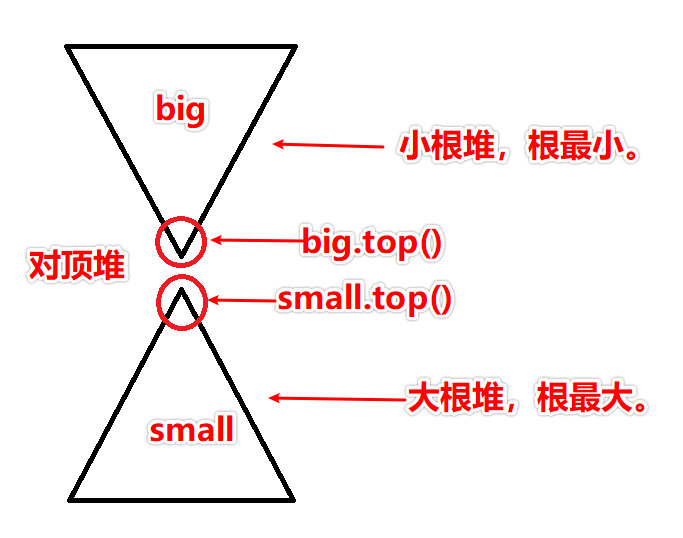
其实就是利用中位数是最中间的数字的特点,将数字按大小分为个数相等的两部分(或数字较小的部分元素个数可以比数字较大的部分多1):
- bigger_nums:较大的一部分数字,它是一个堆顶为最小值的堆;
- smaller_nums:较小的一部分数字,它是一个堆顶为最大值的堆。
经过这样巧妙地设计后,当元素总数为奇数时,中位数为smaller_nums的堆顶;元素总数为偶数时,中位数为bigger_nums的堆顶与smaller_nums的堆顶的平均值。
具体的做法为:
- 将新到的数字插入smaller_nums
- 将smaller_nums的堆顶元素移除,插入bigger_nums
- 若bigger_nums中的元素数比smaller_nums中的元素多,则进行调整,将bigger_nums的堆顶元素移除,插入smaller_nums
- 按照“当元素总数为奇数时,中位数为smaller_nums的堆顶;元素总数为偶数时,中位数为bigger_nums的堆顶与smaller_nums的堆顶的平均值”的策略返回中位数。
方法二:插入排序
由于需要将元素插入一个已排序的列表中,同时保证插入后的列表仍有序,因此想到了插入排序。
总的思路就是新来一个数字后就进行插入排序,最后根据数组的下标返回中位数。
在插入排序时,将插入的过程按照二分查找进行了优化,也叫二分插入排序。
方法三:multiset
multiset底层由二叉搜索树实现,且是有序的,插入操作的时间复杂度为O(logn)。
该方法与插入排序类似,也是利用O(logn)的时间复杂度来进行插入并排序,然后找出中位数。只不过multiset不支持用下标进行访问,因此需要使用指针来实时追踪中位数的位置。又因为中位数可能是由两个值计算而来的,因此需要两个指针。
在写代码时,需要按照以下情况考虑:
- 插入前的元素个数是0/奇数/偶数
- 插入的元素与两个指针当前所指的数字的大小关系
其实在本子上简单的写写画画就能清楚了。
另外使用C++的multiset
- 插入操作不会影响iterator本来指向的值
- 当multiset中已经有值a的情况下再插入值a,新a会插在旧a后面
关于这两个性质的测试可以见代码中main函数的测试部分。
代码
#include <vector>
#include <math.h>
#include <limits.h>
#include <string>
#include <iostream>
#include <queue>
#include <set>

using namespace std;

// 错误方法,中位数是*有序*列表里中间的数,要有序!
class MedianFinder1 {
public:
    vector<int> nums;
    /** initialize your data structure here. */
    MedianFinder1() {

    }

    void addNum(int num) {
      nums.push_back(num);
    }

    double findMedian() {
       int n = nums.size();
       if (n % 2 != 0) { // 奇数
         return double(nums[(n-1)/2]);
       } else { // 偶数
         return double(nums[n/2-1] + nums[n/2]) / 2;
       }
    }
};

// 插入排序
// 时间复杂度O(n):二分查找O(logn) + 插入后挪元素O(n)
// 空间复杂度O(n),用于保存输入(咋有时只算额外空间有时算本身+额外...)
class MedianFinder2 {
public:
    vector<int> nums;
    int n;
    /** initialize your data structure here. */
    MedianFinder2() {
    }

    void addNum(int num) {
      n = nums.size();
      if (n == 0) {
         nums.push_back(num);
      } else {
         // 二分查找+插入 注意这里insert和lower_bound的结合使用
         nums.insert(lower_bound(nums.begin(), nums.end(), num), num);
      }
    }

    double findMedian() {
      n = nums.size();
      if (n % 2 != 0) { // 奇数
         return double(nums[(n-1)/2]);
      } else { // 偶数
         return double(nums[n/2-1] + nums[n/2]) / 2;
      }
    }
};

//https://leetcode-cn.com/problems/find-median-from-data-stream/solution/feng-xian-dui-chong-dui-ding-dui-qiu-zho-a36j/
// 两个堆
// 时间复杂度O(logn)
// 空间复杂度O(n)
class MedianFinder3 {
public:
    priority_queue<int> smaller_nums;
    priority_queue<int, vector<int>, greater<int>> bigger_nums; // 注意这里的写法
    /** initialize your data structure here. */
    MedianFinder3() {

    }

    void addNum(int num) {
      // 先插入小堆
      smaller_nums.push(num);
      // 进行平衡
      bigger_nums.push(smaller_nums.top());
      smaller_nums.pop();

      // 大堆不能比小堆多
      if (bigger_nums.size() == smaller_nums.size() + 1) {
         smaller_nums.push(bigger_nums.top());
         bigger_nums.pop();
      }
    }

    double findMedian() {
      if (smaller_nums.size() > bigger_nums.size()) {
         return smaller_nums.top();
      } else {
         return float(smaller_nums.top() + bigger_nums.top()) / 2;
      }
    }
};

// multiset法
// 时间复杂度O(logn),插入操作需要耗费O(logn)
// 空间复杂度O(n),额外空间O(n)
class MedianFinder {
public:
    multiset<int> nums;
    multiset<int>::iterator left, right;

    /** initialize your data structure here. */
    MedianFinder() {

    }

    void addNum(int num) {
      int n = nums.size();
      nums.insert(num);


      if (n == 0) {
         left = nums.begin();
         right = nums.begin();
      } else if ((n % 2) == 1) { // 原本是奇数个数字
         // 如1  2  3
         //     ↑↑
         if (num >= *left) {
            ++right;
         } else {
            --left;
         }
      } else { // 原本是偶数个数字
         // 如1 3 5 7
         //     ↑ ↑
         if (num >= *left && num < *right) {
            ++left;
            --right;
         } else if (num < *left) {
            --right;
         } else {
            ++left;
         }
      }
    }

    double findMedian() {
       return float(*left + *right) / 2;
    }
};

int main() {
   // 对multiset<int>::iterator的测试
   multiset<int> test;
   test.insert(1);
   test.insert(3);
   test.insert(4);
   multiset<int>::iterator it;
   it = test.begin();
   it++; // it指向3
   test.insert(2); // 此时it指向的还是3,没有被插入的2影响
   it--; // it指向2
   test.insert(2);
   it--; // it指向1,证明插入已有值时,是向后插入的


   double median{0.0};
   MedianFinder* obj = new MedianFinder();
   vector<string> actions = {"MedianFinder","addNum","findMedian","addNum","findMedian","addNum","findMedian","addNum","findMedian","addNum","findMedian","addNum","findMedian","addNum","findMedian","addNum","findMedian","addNum","findMedian","addNum","findMedian","addNum","findMedian"};
   vector<vector<int>> nums = {{},{6},{},{10},{},{2},{},{6},{},{5},{},{0},{},{6},{},{3},{},{1},{},{0},{},{0},{}};

   for (int i = 0; i < actions.size(); ++i) {
      if (actions[i] == "MedianFinder") {
         ;
      } else if (actions[i] == "findMedian") {
         cout << obj->findMedian() << endl;
      } else {
         obj -> addNum(nums[i][0]);
      }
   }
   int a=0;
}
收获
- 堆的那种方法确实很神奇
- 学习了一下插入排序
- 学习了下c++的multiset